Saturday, 10 September 2011

Terrorism - Some are More Equal

One more terrorist attack, some more lives gone and all our politicians, those self called leaders who are actually our servers (not “rulers” as Mr. Chidambaram loves to call himself) have to say is – it will take time, we are used to it. And look at some pathetic statements that have come. Our Prime Minister says “... obviously there are unresolved problems and weaknesses in our system.. “  Did he not feel ashamed of saying so? The BJP Leader L.K.Advani slams the Congress but has nothing to show about what their party has done. Mrs. Sushma Swaraj talks of non-installation of the CCTVs as though this was the single factor which would have eliminated the attack or led to the terrorists. And the less said about some of the others, the better. Let them at least have the courtesy of shutting up when the common man grieves.

Let’s not only have talk of zero-tolerance, let’s have some real action.
Let us have some exemplary punishments – each time there is a successful terror attack let at least the following be dismissed ON THE SPOT without any benefits, and with no right to take any future assignment that draws on public funds.

-          The top man or woman heading the Police in the State, the district, the specific Police Station.

-          The top man or woman in the country in RAW, IB and all other intelligence agencies, and their counterparts at corresponding lower levels.

-          The Member of Parliament, the Member of the Legislative Agency in that area.

-          The Home Minister of the Union and of the concerned State.
Of course there will be several who will say that this is not fair, that before any punishment the concerned should be allowed to exercise their right to defence – but then the victims of the terror attack who are usually ordinary citizens are not given any right to defence, any say in the matter? Why then should rights be given to those who have taken on certain responsibilities but failed to discharge them or to ensure safety? If there is a strong feeling of injustice, the family members of those dismissed can be given Rs. 0.10 lacs to Rs 1 lacs or whatever compensation is immediately announced by the State authorities to those who are injured (NOT those who lost their lives) in the attack. In India today, where the politicians and bureaucracy enjoy the benefits of lax or no accountability, let’s see if terrorism continues unabated even when the concerned functionaries have to put their jobs and their reputation on the line.

 We also had politicians making their standard visits to the hospital which resulted in aggravating the difficulties of the victims and their families. It would perhaps have been more helpful if they had stayed away, had deputed a few capable staff to help on the ground, announced helpline phone numbers and monitored the calls and responses at these numbers, ensuring that the affected persons were not facing any difficulties and getting maximum support at this traumatic time.
We have cases of mercy petitions in respect of those who have been found guilty of acts of terrorism. While not going into the merits of the individual cases, I strongly speak out against those of our politicians who have asked for clemency. If they feel that convicted terrorists need leniency let them first put their money where their mouth is – are they willing to give up their Z – security (or other security) cover? Are they willing to take the same risk to their life and limb that they expect the common man to take. And if not, if they want special rights of protection let them at least not be brass-faced enough to speak out at the cost of the lives of ordinary citizens, while living in fortresses themselves.

I agree that the issue of a timely decision on mercy petitions is well taken, no steps appear to be taken to plug the loopholes in the system and till then those on the death row continue to enjoy high security cover.  As a taxpayer I see no reason why my hard-earned money should be so grossly misused.

Enough of people living in ivory towers and adopting a high-falutin’ attitude.

Saturday, 27 August 2011

Air India on ventilator - lack of Succession Management

Air india is on the ventilator. In the recent past Air India has had so many emergency treatments that one wonders if these are an easy way to get priority treatments guaranteeing quick attention by doctors. Why does our national carrier need such treatments so frequently? It has been suffering with multiple diseases for quite some time now; some of which may be due to wrong decisions by the government or the airlines itself. Airlines industry by its very nature is an oligopolistic industry making entry and exit difficult. Further, scale of economies works only up to a level, and beyond that the advantage of scale may not be there. This was amply established by a study conducted by the British Government in mid-seventies. Was any scientific study made by the airlines or the government before the merger to determine if the merger was going to be useful or was it just the conjecture and enthusiasm of some individuals which led to the merger? Whether the merger of Indian Airlines and Air India has actually paid off in terms of economies of scale is not known. There is perhaps no post-merger study undertaken to establish this aspect. Can the mounting losses of Air India now be attributed to a wrong decision of the government or the airlines? The answer is visibly yes as there have been severe losses! 
About thirty years back both Air India and Indian Airlines were renowned airlines of the world with a competitive fleet, competent flight crew and quite robust maintenance systems. At that time both the airlines were managed by aviators or persons with excellent background and experience in aviation. The DGCA, the regulatory body, was also headed by experienced aviation persons until early nineties but since then it has been headed intermittently by administrators not having any regulatory experience in the area of aviation.  The beginning of this trend could be traced back to the appointment of India’s representative in the International Civil Aviation Organization in the mid-eighties when for the first time a non-DGCA official was appointed the representative, since then the position has been occupied by people not having any professional exposure to aviation.  This practice was slowly extended to our national airlines and we have not heard since then that these airlines are doing well. Many of us will recall that when the merger was being discussed Indian Airlines went through a name change and all its fleet was repainted with a new logo etc. It has been repainted again with Air India colours. Repainting an aeroplane like B737 may cost about Rs 60-70 lakhs (www.airliners.net & www.blog.airbaltic.com) considering the paint has to withstand extreme temperatures, humidity, wind speeds, encounter with abrasive objects and remain flexible. In addition, repainting will add to the operating empty weight of an aeroplane eating into the payload and hence loss in revenue. One is talking of about Rs 60-70 crores expenditure on a fleet of 100 aeroplanes, which adds up to Rs 120 crores if the fleet was repainted twice. Did anyone take this into account while deciding on the name change or has anyone now questioned these expenses?
Let us look at the difference in the safety standards followed in civil aircraft industry as compared to other industries. A civil aeroplane is designed to maintain safety levels such that only one incident should take place in one million flights and this level is ensured through tight control over many design and operational parameters. No industry of any sort follows such high safety standards. An aeroplane is a precision machine with a factor of safety of only 1.5. Even then the machine is one of the safest machines. No overdesigning is recommended as that will spoil the economics of operations. In other transport industries the safety margins have been much higher. In civil engineering industry the margin of safety could be many times higher going from 10 to 30. The point being made is that you cannot appreciate the sensitivities of the industry if such finer points are not known to and understood by you. Achieving such severe standards (one incident in one million flights) demands very close working between maintenance, operational and management teams. No team can be superior to others and each operational change needs to be carefully thought out. Such a safety level cannot be achieved on a continuous basis by writing orders on files because such orders are not understood by aeroplanes. There is a large element of practical and conceptual skills and professionalism required to attain such goals.
The situation today is that all the essential organizations Air India, the Civil Aviation Ministry and DGCA are headed by people of the same service with very little experience in aviation and there is no difficulty in drawing some obvious conclusions - continuous costly emergency treatments at the cost of tax payers. Are there any other airlines in the country which are managed operationally by non-aviation persons? The answer would be no. One wonders if tomorrow Indian Air Force will be headed by some generalist and slowly all related wings will have the same fate. One would not be surprised as this is how the decision makers have started thinking in the recent past. And would we accept this at the cost of national security? Why should we then sacrifice professionalism for the benefits and fancies of some select people? The irony is that the government does not find any senior person within the airline to take the responsibility (and who is at fault for not building a succession line?) but again finds that a person inexperienced in aviation can head the airlines! How and why should the board of directors be happy to work under the chairmanship of a joint secretary level officer? We are very good at knee jerk reactions because there is hardly any accountability of officers of the airlines, ministry and other related departments and it has become so easy for each successor to put the blame on predecessors. The tax payer keeps paying the price. Imagine how many mid-day healthy meals can be provided to needy children with the subsidy being awarded to Air India which is comparable to the many scam figures. We are not accustomed to think in terms of opportunity costs because the governmental system does not believe in reaching out to its clients, the people, but always wants clients to come to them with their problems so that the officers can dole out help and keep the people either obliged or subjugated. Anyway that is a much larger issue.
We cannot afford our national carrier to be on a ventilator or allow it to die. When our people are stranded in foreign countries due to local disturbances, it is the Air India which lifts them back to India. Private airlines are not matured enough to play that role. Political bosses, civil servants and aviation experts have to put their minds together and find a long term solution. What we need is professional management trained in aviation business helped by a competent technology team. Outsiders from the industry should not be encouraged yet again to head these organizations. Instead a robust succession plan should be put in place. As an Indian I would like Air India to be a competitor for undertaking space tourism whenever it becomes a reality and for the present and the future we need to institute good knowledge management systems. 
(Contributed by Raghav) 

Friday, 26 August 2011

Anna Hazare's movement and International perception

An issue that needs consideration is how the international community will view this whole movement and its aftermath? The huge scams being investigated presently would have given a clear indication that big corruption is taking place in the country and this does have the direct or indirect involvement of government officials and ministers at the National or the State level. Then Anna Hazare’s movement and its significant support across several cities would have clearly brought out that the common man in India is also agitated about the extent of corruption in India and that the issue is not restricted either in activities it covers or its geographical coverage.

The Prime Minister proudly announced that nobody can question his integrity – it is a sorry state of affairs where he could only say the same for himself and not for his party MPs or even his Ministers. And of course this begs the question – what is honesty? Is it only the taking of money to perform certain acts? This is a very simplistic approach. What about non-performance of acts or more specifically being a mute spectator to obvious wrong-doings? And is mere money the only form of gratification? What about accepting continuance of position as being the quid pro quo? Is it not well said that if power corrupts, absolute power corrupts absolutely. In this context would Mr. Manmohan Singh still be able to reconcile his stated honesty with his conscience or would he like to rethink on his statement?

The world will be watching to see what happens. Perhaps the contents of the Lokpal Bill finally promulgated may itself not be so important. The issue really is – do our elected representatives give a firm message that they are interested in reducing corruption in the country and so take some quick and effective measures to plug loopholes, to bring in transparency and to reduce corruption? Or do they have endless discussions and debates, continue posturing, procrastinate on strict measures for another few decades and continue to allow elected representatives with criminal, corrupt or other questionable background, to flourish?

And if the latter does happen then the prestige of the country will only sink perhaps rock bottom and the world will be convinced that the governance of the country consciously allows and supports corruption. Then where will be our political prestige, our pride in being the largest democracy? And what about the huge economic repercussions on FDI, exports etc. Our politicians need to consider this in all seriousness and perhaps the media too.

Saturday, 20 August 2011

Sycophancy at taxpayers' cost

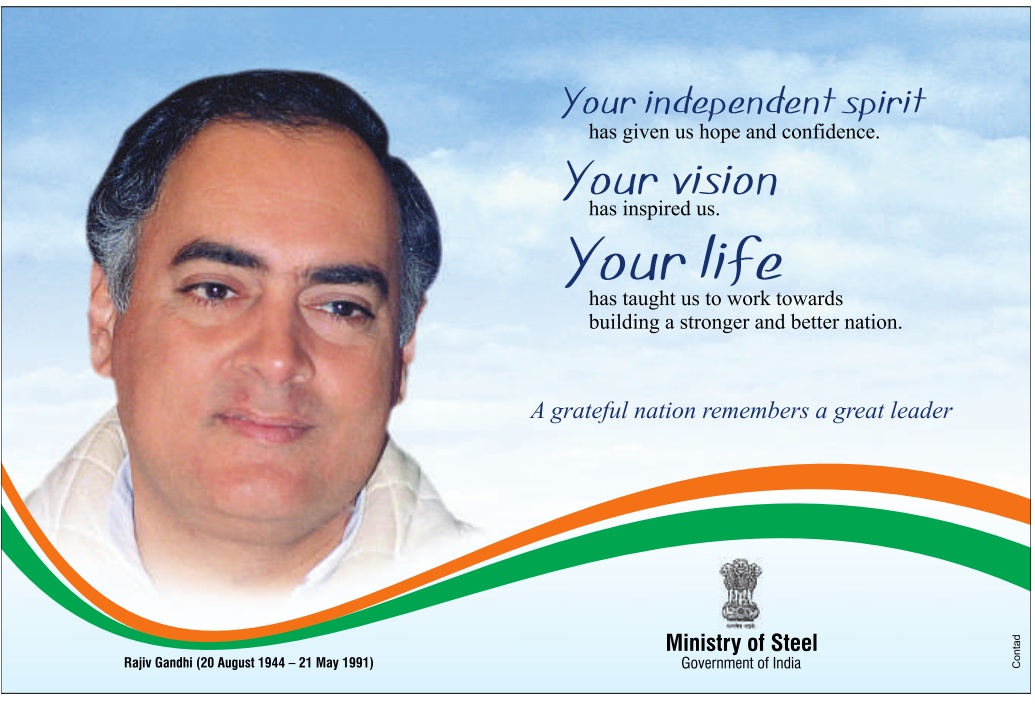
Today’s newspapers are full of huge advertisements on the occasion of the birth anniversary of Shri Rajiv Gandhi. In the two newspapers itself that I read I see huge advertisements from the Government of India’s various ministries - Ministry of Information and Broadcasting, Ministry of Steel, Ministry of Micro, Small & Medium Enterprises, Ministry of Power, Ministry of Health & Family Welfare, Ministry of Tourism, Ministry of Housing & Urban Poverty Alleviation, Ministry of New and Renewable Energy, Ministry of Women and Child Development, Ministry of Social Justice & Empowerment, Ministry of Commerce and Industry.

Then there is the Delhi Govt through its Directorate of Information and Publicity, Govt of Rajasthan through Dept of Information and Public Relations, besides various autonomous bodies such as Navodaya Vidyala Samiti and Coir Board. And while 20th August is already called Sadbhavana Divas, the Ministry of New and Renewable Energy went a further step ahead and also called it the Rajiv Gandhi Aksay Urja Divas. 

Similar advertisements would have appeared across the across other newspapers both national and local and also in vernacular languages, each ad costing in crores.

Why have these ads been brought out? Was there a diktat issued? Or did the concerned just feel the urge to celebrate this day? Do they do so on the birth anniversary of all the erstwhile Prime Ministers of our country? How far will this sycophancy last and when if ever will it end?

For some time now we have also been seeing that photographs of other leaders – the Chairperson of the UPA, the Prime Minister, Central Ministers and Ministers of State, Chief Ministers, State Ministers , Chairmen, Secretaries  etc. have started featuring in Govt. Advertisements – whether in newspapers or public hoardings.

While political parties doing this out of party funds is unexceptionable, is this legitimate publicity expenditure for government departments and agencies? The National Commission for Women was intelligent enough to use the occasion to advertise the rights of women, most are just blatant shows for a vested interest. Is anybody questioning these huge expenses from the taxpayers’ money which could better have been used by each ministry and office to improve their own activities for the welfare of the public which they profess to look after? 

Is this also not a matter for CAG or CVC to look at suo moto? The Mission Statement of the Comptroller and Auditor General (CAG) of India which is the Supreme Audit Institution of India states its Mission to be

MISSION: Our mission enunciates our current role and describes what we are doing today: Mandated by the Constitution of India, we promote accountability, transparency and good governance through high quality auditing and accounting and provide independent assurance to our stakeholders, the Legislature, the Executive and the Public, that public funds are being used efficiently and for the intended purposes.

Looking at this, does CAG find such expenditure to be within the scope of public funds being used efficiently and for the intended purposes? And what about the Internal Finance Divisions (IFD) of various departments – what are they doing when such bills come to them for approval?

The ads shown above do not talk of any activity of the concerned government authority nor do they draw attention to any scheme prepared for the welfare of the public. Are the amounts spent for purposes for which they are authorised? Are such huge advertisements, which actually aim at the publicity of some individuals or groups, not a misuse and a form of corruption?  Which offices issued such ads and which did not? Which officials who authorised these gain from such wasteful expenditure of the exchequers’ funds and which officials went out of favour because they did not?  Surely this is a matter for the Central Vigilance Commission (CVC) to look at?

Friday, 22 July 2011

Corruption - political compulsion in India

It will not be very wrong to say that to a large extent corruption takes place with the connivance of our political masters. Politicians have this compulsion of gathering money to achieve and maintain political power. Unless we tackle corruption perpetrated by politicians, no commission, committee or Jan Lokpal Bill can reduce corruption.

Basic question - why are our politicians corrupt (or like Manmohan Singh turn a blind eye towards corruption)? The roots of corruption lie in our political system. Any party needs 51% of elected representatives to form government, be it in state or centre. Since parties are not able to win 51% of the seats, they have to either buy MLAs/MPs (to make-up 51%) or form coalition Government. For buying MPs/MLAs parties need to generate black money and for forming coalition government parties have to offer posts of Ministers to their coalition partners, who wield immense power and cannot be checked by the Prime Minister or Chief Minister and make money while they can. Besides this, the Ruling party is unable to stick to its promised agenda because of arm twisting by its coalition partners.

To sum up, there is no way corruption can be reduced (forget about eradication) from India unless our political system is rectified. There are other systems followed in different countries which tackle this problem of 51% representation.

I am surprised, why no-body talks about correcting our political system, and we are wasting energy in devising inconsequential schemes for tackling corruption.

(Contributed by Tishya Kumar Bhatia, Ann Arbor, USA)